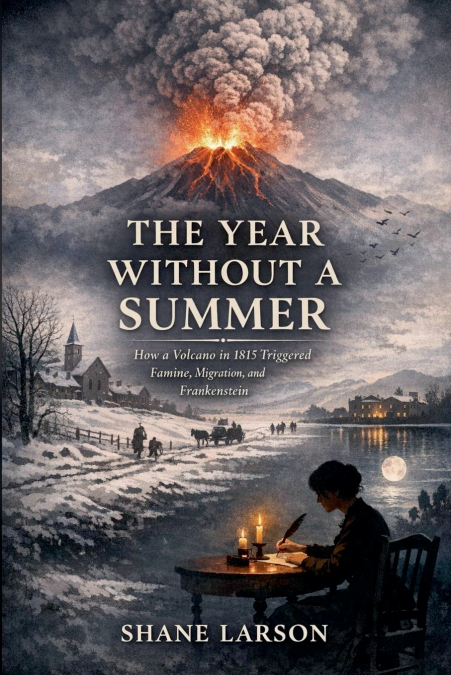
Shane Larson
In April 1815, a mountain in the Dutch East Indies blew itself apart and changed the world. Almost nobody knows the story.Mount Tambora’s eruption was the largest in recorded human history - roughly four times the size of Krakatoa, well over a hundred times the size of Mount St. Helens. Tens of thousands died on Sumbawa and the islands around it. Then the sulfur reached the stratosphere, wrapped the planet in a thin chemical veil, and the climate broke.The summer of 1816 brought snow in June across New England, frost in every month of the year, and crop failure across a vast belt of the Northern Hemisphere. In Switzerland, trapped indoors at the Villa Diodati by relentless storms, Lord Byron and the Shelleys passed the time inventing modern horror - Frankenstein was born of that summer’s weather. In Ireland, a failed potato harvest triggered a typhus epidemic that killed tens of thousands, rehearsing the catastrophe of 1845. In Yunnan, poets wrote of frozen rice paddies. In Germany, oats grew so expensive that horses starved by the thousands, and in that same hungry year an inventor named Karl Drais unveiled the ancestor of the bicycle.This is the story of one volcanic eruption and the chain reaction it set in motion across the planet - famine, disease, mass migration, financial panic, religious revival, technological invention, and a handful of immortal works of art. It is a story about how thin the membrane is between civilization and the weather.What you’ll learn:How a single eruption disrupted food, finance, art, and disease on every inhabited continentWhy Frankenstein and the first vampire story in English were both written in the same dark roomHow the Irish famine of 1816 foreshadowed 1845 - and why almost no one remembers itHow climate refugees from Vermont and New Hampshire reshaped the American interiorWhy the first bicycle appeared in a Germany whose horses were starvingHow a volcano four years earlier helped cause the first true American depressionWhat a Tambora-scale eruption would do to global food systems todayThis book is for you if:You read narrative history that treats the natural world as a character in human affairsYou want the climatological backstory to Frankenstein and the Romantic poetsYou read about climate, environment, and the fragility of human systemsYou enjoyed Shane Larson’s Collapse Pattern series and want a natural-disaster companionYou like books that connect a single event to its planetary consequencesThe mountain is still there. It is still active. The story of what it did the last time is the story of how a planet works - and how easily it stops working.