Shane Larson
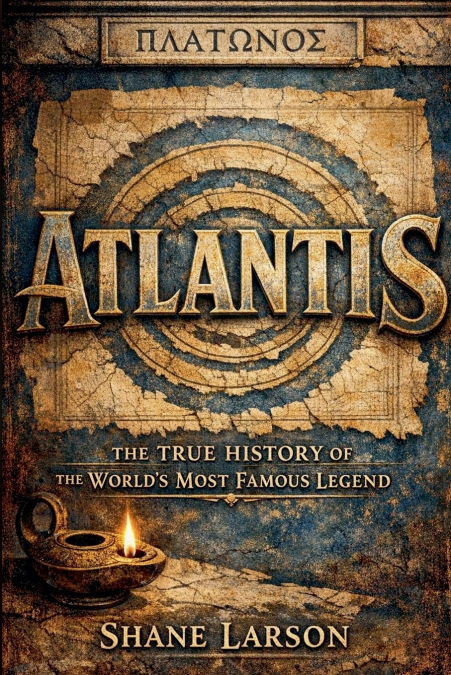
Atlantis was invented by one man, for one purpose, and we know his name.Everything the ancient world recorded about Atlantis fits in about twenty pages of two dialogues by Plato, written in the 350s BCE. No Greek writer before him mentions it. No Egyptian document does. Every ancient author who discusses it afterward is discussing Plato, and says so. And the second of the two dialogues stops mid-sentence, with Zeus about to pronounce judgement on the island. Plato never finished it.This is not a book that finds Atlantis. It is the history of the idea: how a philosopher built a sea empire to lose an argument, what real materials he built it from, and why an unfinished thought experiment became the most durable idea in Western pseudo-history-searched for by Jesuits, congressmen, mystics, admirals, divers and television crews, on every continent and under every ocean.Part of the answer is that Plato had the materials to hand. In 373 BCE, inside his own lifetime and two days’ travel from Athens, the Greek city of Helike was destroyed in a single night by earthquake and sea, and its ruins lay visible under the water for centuries. A drowned city was not an exotic hypothesis for him. It was the news. The rest of the answer lies in what people have needed the story to do since: a Victorian public that had just watched Troy dug out of the ground, a spiritual movement that wanted a prehistory for the soul, a Cold War navy with sonar pointed at the seafloor, and a streaming economy in which a mystery earns more than a correction.What you’ll learn:What the Timaeus and Critias actually say, in order-most readers of Atlantis books never have, and it is shortWhy Plato, an old aristocrat of a defeated naval empire, needed an enemy for his ideal AthensThe case for Thera at full strength, and what it costs to accept the rescues that make it fitTartessos, the Azores, Antarctica, Bimini-and the one class of theory that geology killed outright in the 1960sThe single method every candidate claim uses, taught plainly enough that you can run it yourselfHow an 1882 bestseller by a Minnesota congressman became the source of nearly every modern claimThe legend’s passage through Theosophy, and its documented political misuse in the twentieth centuryWhy every new sensor, from sonar to satellite, finds the same number of AtlantisesHelike, Pavlopetri, Doggerland, Akrotiri: the drowned places archaeology really did findThis book is for you if:You have watched the lost-civilization documentary and want the sober version afterwardYou read the history of ideas, and care more about why a story survives than whether it is trueYou are a skeptic who is tired of books that either believe or sneerYou want the third volume of the Minoan arc to close the question the first two left openArchaeology did find sunken cities. They are better than the one we were told to look for.