Shia Heritage Foundation
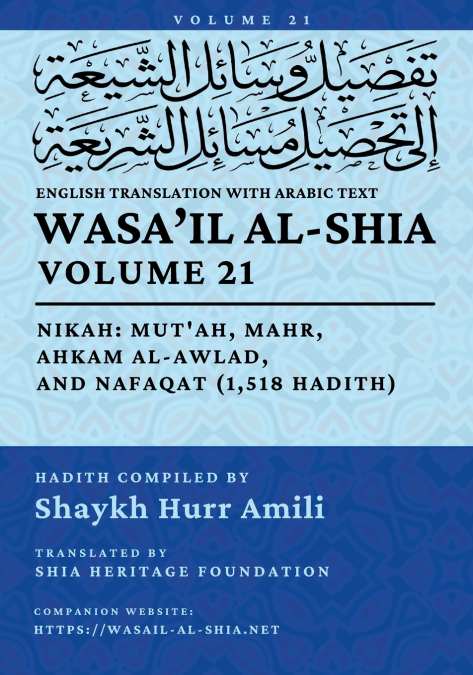
'Wasa’il al-Shia' stands as one of the most monumental collections of Shi’i jurisprudential hadith, rigorously documenting every dimension of religious law. Compiled by the illustrious Shaykh Hurr Amili (d. 1693), this encyclopedic masterpiece comprises approximately 36,000 traditions across 30 volumes.Driven by the necessity of engaging directly with the explicit words of the Ahl al-Bayt, Shaykh Hurr Amili designed this collection as a complete, self-sufficient constitution for both knowledge and practice. Systematically organized by topic, the work aggregates traditions from reliable and mass-transmitted textual sources, expanding beyond the Four Canonical Books to gather the preserved notebooks of the early faithful.Above all, it serves as an unaltered conduit to the Infallibles, offering the greatest gift possible: the ability to base one’s religion firmly upon the pristine teachings of the Ahl al-Bayt.Volume 21 systematically explores the remaining dimensions of Islamic family law and domestic relations. It begins with an extensive analysis of Mut’ah (Temporary Marriage), detailing its conditions, specified durations, and the absence of inheritance rights. The volume then addresses the specific regulations governing the marriage of male and female slaves (Nikah al-’Abid), including the necessity of a master’s permission and the rules regarding intimacy through ownership. It further covers the jurisprudential consequences of concealed defects in a spouse and provides comprehensive rulings on the Mahr (Dowry), establishing the wife’s right to it upon consummation. The text also outlines the rules for dividing time among multiple wives, handling marital discord, and the profound legal and ethical rights concerning children (Ahkam al-Awlad). Finally, it concludes by detailing Al-Nafaqat, the strict obligations of financial maintenance required for wives, children, parents, and even owned animals. Translated by the Shia Heritage Foundation, this edition provides researchers, university students, and seminarians with a precise, authoritative text. It stands as an indispensable resource for the rigorous study of classical law and the practical implementation of early jurisprudential doctrine.