Marcelo Ungarit
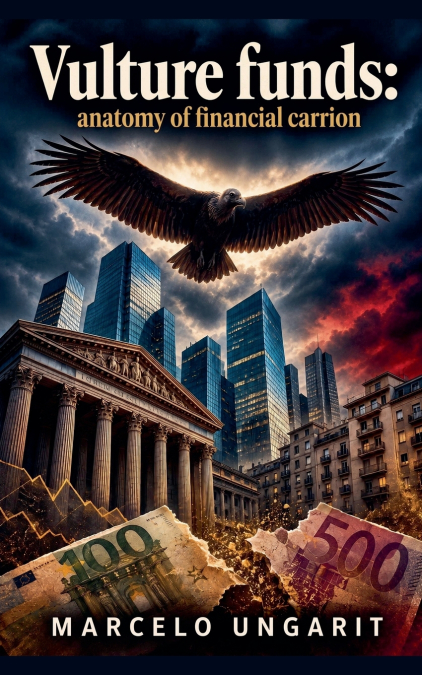
When an individual or a business goes bankrupt, the law protects a vital minimum to prevent debt from destroying their existence. When an entire country falls into crisis-or thousands of families are trapped in securitized mortgages-the global financial order inverts that moral boundary, shielding the profits of a speculative minority at the expense of the daily lives of millions.How does a handful of opaque firms-often registered in tax havens and run by bankruptcy litigation lawyers-manage to twist the arm of sovereign states, seize warships in foreign ports, drain healthcare and education budgets, and end up setting rent prices in working-class European neighborhoods?Vulture Funds: Anatomy of Financial Carrion dismantles, piece by piece, the legal, tax, and political machinery of a business that achieves higher profit margins than drug or arms trafficking, yet operates with the enforcement backing of courts in New York and London. Across thirteen meticulously documented chapters, the book reveals how the void left at Bretton Woods in 1944-the absence of an international sovereign insolvency court-along with the dismantling of New York’s old ban on purchasing lawsuits and the extreme mutation of the pari passu clause, turned others’ insolvency into a legal mechanism for upward wealth transfer.Far from stopping at an abstract denunciation, the book traces this predation across two shores linked by the same actors: from the Peruvian dress rehearsal in the 1990s, the plundering of debt-relief programs in Zambia and the two Congos, and the 'trial of the century' against Argentina-whose precedent once again shook U.S. courts in January 2025-to the post-2008 landing in Western metropolises. Greece, Puerto Rico, Ireland, and Spain show how bank bailouts and 'bad banks' handed over sovereign debt, urban land, historic businesses, and more than 115,000 rental homes to the very same asset managers laying siege to the Global South.Written with analytical rigor and an accessible voice, this essay also examines why current informal and contractual stopgaps fail, laying out the decisive crossroads of our century: remaining trapped in the quicksand of perpetual debt, or building a democratic way out through a United Nations Framework Convention, a public registry of beneficial owners, and audits capable of placing human life above financial contracts.