Sandeep Chavan
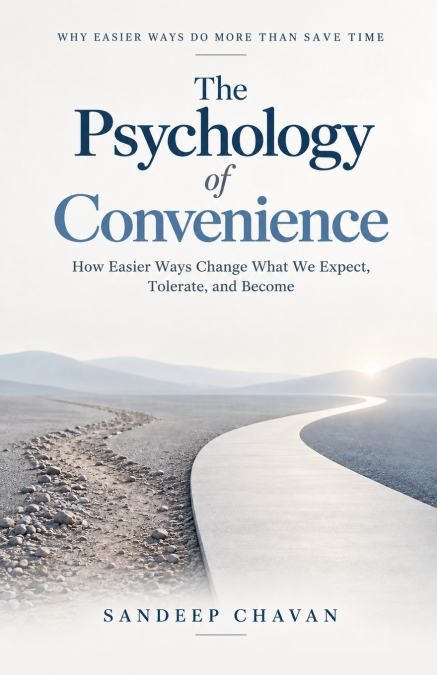
Convenience rarely feels important while it is working.We take the shorter route. Search instead of remembering. Let a map navigate. Allow software to calculate. Order instead of going out. Delegate a task to someone who already knows how to resolve it. Increasingly, we allow intelligent systems to assist with work that once demanded more of our direct participation.Each choice seems small.Repeated often enough, however, the easier way can change the person choosing it.In The Psychology of Convenience, Sandeep Chavan examines convenience not merely as comfort, efficiency, consumer behaviour, or technological progress, but as an experienced reduction of required resolution participation.Why can the same pathway feel convenient to one person and burdensome to another? Why does yesterday’s luxury become today’s minimum expectation? Why can a five-minute wait feel acceptable in one setting and intolerable in another? What happens to skills we no longer need to practise? Does convenience reduce tolerance-or release it for more consequential problems? When does a preferred pathway become a dependency? And when a burden disappears from our experience, has it truly disappeared-or has someone or something else taken responsibility for resolving it?Moving from everyday choices to technology, automation, infrastructure, money, labour, institutions, and artificial intelligence, the book develops a wider psychology of the easier way.It explores how convenience moves through a recurring sequence: relief → repetition → familiarity → expectation → normalisationand how that movement can alter waiting, tolerance, skill, capacity, delegation, and dependence.The book makes several important distinctions:Tolerance reduction is not the same as tolerance reallocation.Convenience can release capacity without necessarily building capacity.Not needing to perform a resolution is not the same as being unable to perform it.Convenience is experienced locally but produced systemically.Transferred burden is not eliminated burden.This is neither a defence nor a criticism of convenience.Difficulty is not automatically valuable. Ease is not automatically harmful. Human progress depends on reducing burdens that no longer deserve our participation.The more mature question begins after the burden has been removed.What happens to the time we save? The attention we release? The physical effort we no longer need? The cognitive capacity increasingly supported by machines and AI? The tolerance no longer spent on old forms of friction?And what kind of participant emerges when the easier pathway becomes the normal one?The Psychology of Convenience is an inquiry into one of the quietest forces shaping modern life-and into what the easier way gradually changes while we are busy using it.