Nakel Nikiema
Pope Day was a major street observance in colonial Boston. May Day filled American schoolyards. Mischief Night was a regional institution within living memory. All of them are gone, and almost nobody noticed the funerals.
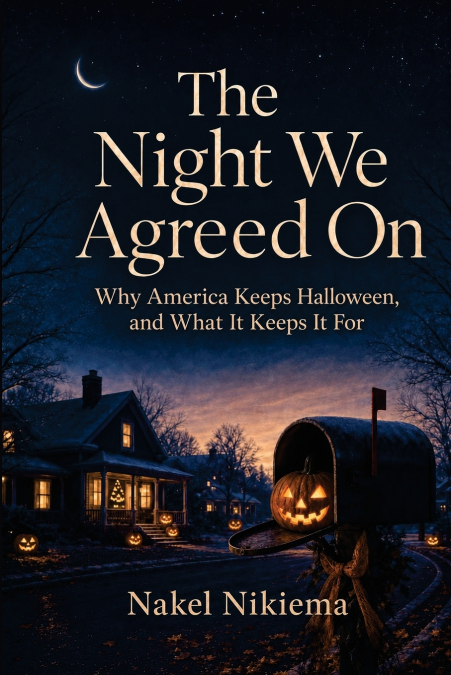
Halloween survived industrialization, suburbanization, two waves of organized religious opposition, a nationwide panic about poisoned candy that had no factual basis, the collapse of the neighborhood as a social unit, and a pandemic that made its central act specifically discouraged. It is now the second-largest commercial holiday in the United States - and the only one widely kept by people who hold no belief, religious or civic, that it represents.
That is strange. This book is about why.
The Night We Agreed On is not another history of Halloween. Four good ones already exist. This is an argument: that the night survives because it performs four jobs American culture has no other mechanism for doing - and that the most valuable of the four is quietly disappearing while every measurement says the holiday has never been healthier.
Along the way, Nakel Nikiema establishes what the evidence actually supports and what it does not:
And then the argument that gives the book its urgency. On one night a year, Americans in large numbers approach the homes of people they have never met, in the dark, and are received at the door - in a country that has spent fifty years engineering the stranger out of domestic life. It is the last mass hospitality rite in American residential life. It is the only one of the holiday’s four functions that nobody can sell equipment for. And it is the one that will go first.
Written with the comparative eye of an African Christian who grew up not with Halloween but with the first of November - the graves cleaned by hand, the Mass for the dead, a child crying in a pew because he had worked out what the day was telling him - The Night We Agreed On is a book about what a culture keeps, what it quietly puts down, and how to tell the difference before it is too late to choose.
For readers of Nicholas Rogers, David Skal, Robert Putnam, and anyone who has ever wondered why a plastic skeleton on a suburban lawn feels like it means something.