Fazal Abubakkar Esaf
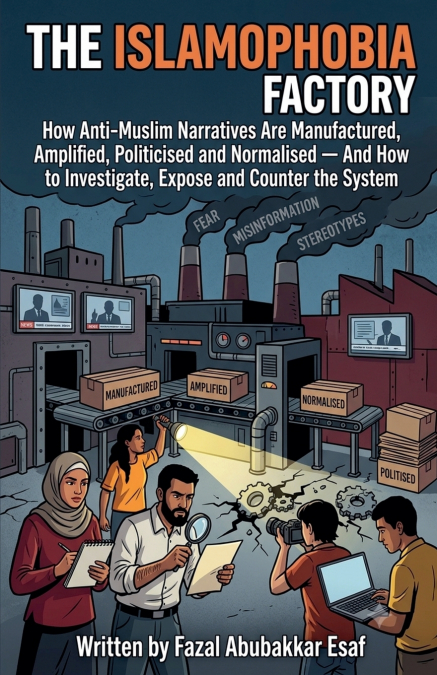
The word Islamophobia is used frequently, but the processes behind anti-Muslim prejudice are often discussed in fragments. One conversation focuses on politics. Another examines the media. Another looks at social media, electoral campaigns, discrimination, security policy, demographic fears, hate speech, or violence. Each may reveal something important, yet the connections between these domains can remain difficult to see.This book begins with a simple question: How does an anti-Muslim narrative move from an idea to a story, from a story to amplification, from amplification to political discourse, and from political discourse to institutional or social consequences? The manuscript deliberately treats this as an investigative question rather than assuming its answer in advance.A network can emerge through formal relationships, financial connections, shared organisations, political alliances, media repetition, common incentives, ideological affinity, or simply the independent behaviour of actors responding to the same environment. These possibilities must be separated rather than collapsed into a single explanation.That is why this book repeatedly returns to evidence. Who made the claim? Where did it originate? What documents exist? Who repeated it? Who amplified it? Are financial relationships documented? What happened before and after the claim? What does the other side say? What evidence could disprove the hypothesis? The book consequently moves beyond the question 'Who hates Muslims?' and asks a more difficult question: What mechanisms allow prejudice to become a narrative, a political resource, a media product, an institutional practice, or a social norm?