Jiazheng Chen
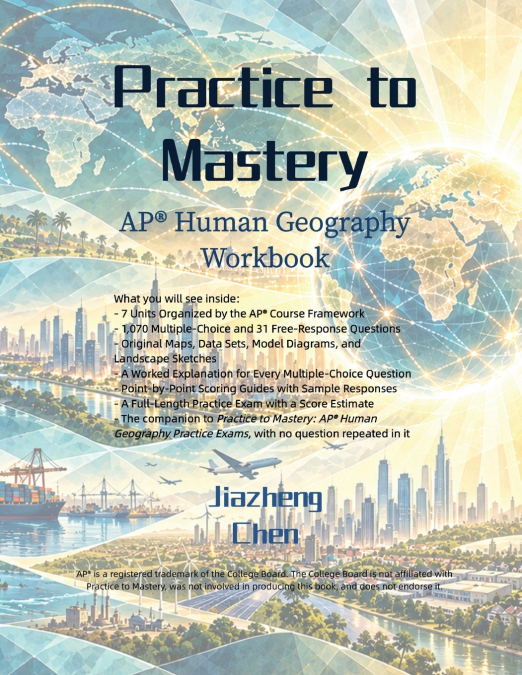
Practice to Mastery: AP® Human Geography Workbook is a question-by-question workbook for students preparing for the AP® Human Geography Exam. It holds 1,101 original questions: 1,070 multiple-choice questions and 31 free-response questions, organized by the seven units of the course and closing with a full-length practice exam.Human geography is learned by applying it. Knowing the definition of distance decay, the demographic transition model, or the bid-rent curve is only the start. The exam asks you to read a map you have never seen, interpret a population pyramid, explain a pattern at one scale and then at another, and decide which model fits a place and why. Every unit is written to train exactly those moves.Within each unit, the questions are arranged in three labeled tiers, Easy, Medium, and Hard, so you can build from the core vocabulary to the reasoning the exam rewards:Unit 1: Maps, Data, and the Lens of ScaleUnit 2: People in Place and in MotionUnit 3: How Culture TravelsUnit 4: States, Borders, and PowerUnit 5: Fields, Farms, and Food SystemsUnit 6: The Shape and Pull of CitiesUnit 7: Factories, Trade, and the Development GapAbout a third of the multiple-choice questions come in stimulus sets of two to four questions built on a shared map, data table, graph, model diagram, or landscape sketch, the way the real exam presents them. Every map and figure in the book was drawn for it, and the places in the data-based questions are invented so that each question tests reasoning rather than memory of a particular atlas. Every key geographic model in the course appears in its own reading questions, including the demographic transition and epidemiological transition models, population pyramids, von Thünen land use, central place theory, the concentric zone, sector, and multiple nuclei models, the Latin American and African city models, bid-rent, rank-size, Weber’s least-cost theory, Rostow’s stages, and world-system theory.Every unit includes four free-response questions in the current exam format: seven points each, parts A through G, rising from Identify to Describe to Explain, with one question without a stimulus, two with one stimulus, and one with two. Every free-response question includes at least one part that asks you to analyze relationships across geographic scales, and many draw on more than one unit. The scoring guide for each lists the point for every part, examples of acceptable responses, and scoring notes, followed by a complete sample response that earns all seven points.The multiple-choice explanations are written to teach. Instead of dismissing the wrong answers one by one, each explanation shows why the correct answer is correct: the concept, the model, or the reading of the map or data that settles the question. That is the reasoning you need to carry into the exam, and reading it after every question, right or wrong, is how the patterns stick.The book ends with a complete practice exam: 60 multiple-choice questions and 3 free-response questions in the format and timing of the real exam, with an answer key that labels the unit of every question, full explanations, scoring guides, and a guide to estimating your score.Every question, answer choice, map, figure, and explanation in this book is original. Content is assigned to units according to the published course framework, and terms outside the course are kept out of the questions.The companion volume, Practice to Mastery: AP® Human Geography Practice Exams, provides twelve more full-length exams with no question repeated from this workbook.AP® and Advanced Placement® are registered trademarks of the College Board, which was not involved in the production of, and does not endorse, this product.