Christopher E. Etter
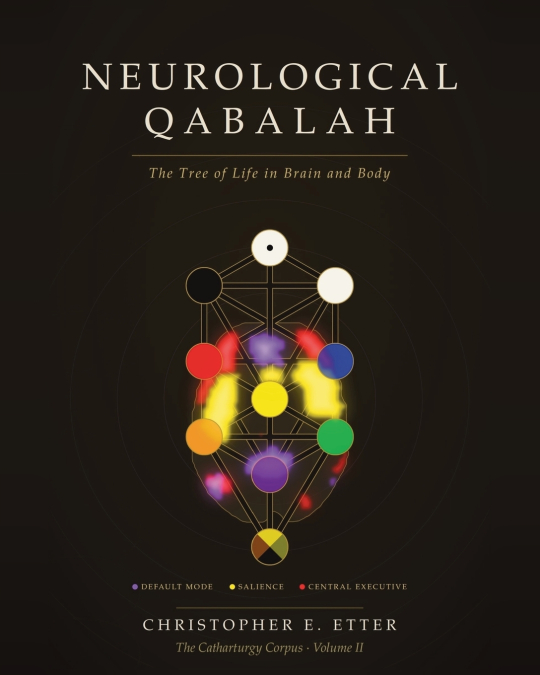
Neurological Qabalah advances a precise and examinable thesis: that the Tree of Life of the Hermetic and Kabbalistic traditions corresponds, station by station, to the large-scale control architecture of the human brain - the paired executive cortices at Mercy and Severity, the temporoparietal junctions at Victory and Splendor, the salience system of anterior cingulate and insula at the Tree’s center, the default-mode network at the Foundation, and the body, with its evolutionarily distinct hindbrain organ, at the Kingdom. The study’s contribution lies as much in its method as in its map. Every proposed correspondence is graded - documented finding distinguished from constructed interpretation - and admitted only under a strict criterion of independent arrival: a convergence counts as evidence solely where tradition and science reached the same structure without contact. On this foundation the book develops its further arguments: a reception of the dual-progenitor account of brain development into the doctrine of the soul’s registers; an evolutionary chronology of those registers; a fourfold analysis of each station’s internal and external offices; and a theory of practice in which classical contemplative disciplines are re-described as the trained governance of identified neural systems. The result is neither reduction nor apologetics. It is an argument, sustained across the volume, that one pattern has been transcribed twice - once in a symbolic tradition, once in cortical anatomy - and a demonstration of what disciplined comparison between the transcriptions can yield for the study of Western esotericism, for the religion-and-science literature, and for the theory of contemplative practice.