Rishabh K Jain
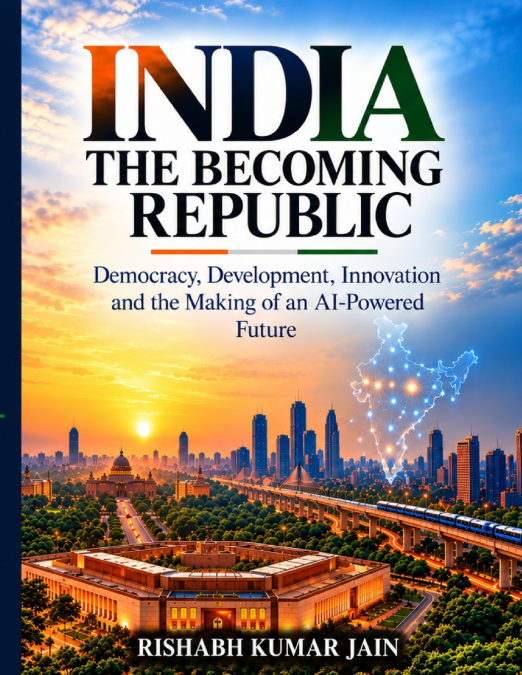
How does a nation of more than a billion people create opportunity, dignity and a better quality of life at extraordinary scale?India: The Becoming Republic begins with history-but it is ultimately a book about India’s future.From Partition, communal violence, displacement and poverty, India faced the immense challenge of building institutions and unifying one of the world’s most diverse societies. The book follows that journey through wars and external threats, political upheaval and democratic correction, economic reform, liberalisation, technological transformation and India’s emergence as a major economic and technological power.It examines achievements alongside failures, asking what successive governments inherited, what they changed, what endured beyond its time, and what India learned along the way.Then the book asks a larger question: what should India build next?For India, development must ultimately create opportunity at enormous scale. AI, agentic systems, robotics and automation may transform existing occupations-but building a more advanced society could also require millions of people to build, operate, maintain and continually improve the systems around it. New opportunities could emerge across manufacturing, engineering, construction, skilled trades, robotics, software, AI, cybersecurity, data centres, energy, healthcare, research, education, logistics, tourism, sport, design, arts and cultural industries-requiring not only engineers and scientists, but technicians, operators, installers, maintainers, trainers, healthcare workers, craftspeople and many other skilled roles.The book explores how physically demanding and historically inherited forms of work could become mechanised, safer, more skilled and better rewarded, creating pathways into technical occupations rather than simply eliminating existing livelihoods. Technology cannot eliminate caste, but greater occupational mobility, education and mechanisation could help weaken the historical connection between birth and occupation.The later chapters explore how AI-assisted systems might improve healthcare across distance, reduce administrative backlogs, strengthen education and public services, modernise sanitation and infrastructure, expand economic opportunity, discover sporting talent and improve health, fitness and everyday quality of life.Looking further ahead, the book considers emerging industries including advanced robotics, AI infrastructure, data centres, scientific research, orbital computing and space exploration-and the human and industrial ecosystems they could create.Many of these later proposals are deliberately speculative and hypothetical. AI agents are already being developed and trialled around the world, but their future capabilities and consequences remain uncertain. The models presented here are therefore not predictions or proven solutions. Readers are invited to examine them with an open but critical mind: some may prove impractical, while others may become increasingly feasible over the coming years and decades.The central principle is simple:Technology should not merely make India more automated. It should help make Indians more capable.India inherited extraordinary challenges, built institutions, survived crises, corrected failures, opened its economy and developed capabilities earlier generations could scarcely have imagined.India is still becoming. This book asks what the Becoming Republic might choose to become next.