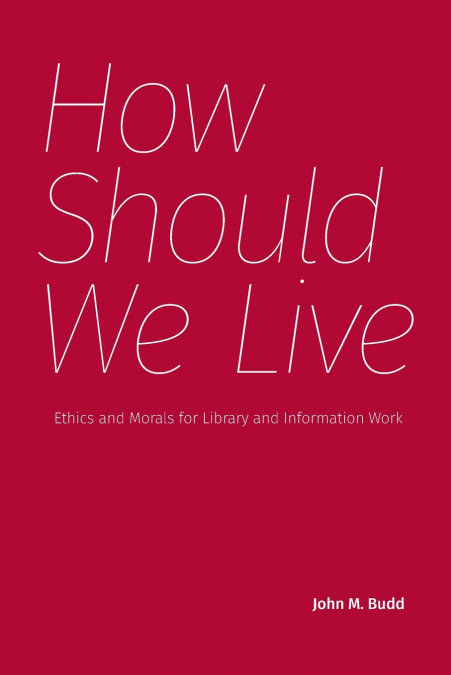
How Should We Live

How Should We Live

John M. Budd

68,45 €
IVA incluido
Disponible
Editorial:
Litwin Books
Año de edición:
2026
Materia
Ética y filosofía moral
ISBN:
9781634002127
68,45 €
IVA incluido
Disponible
Añadir a favoritos

How Should We Live is an extensive examination of the ethical action that can and should be taken in the library and information professions. The book presents a full historical investigation, beginning with the ancients and moving through time to contemporary ethical thinking. Critical eye and mind are applied to the philosophical and practical guidelines that have been suggested in the past and are suggested in the present time. Further, examples of the challenges that face the professions at the current juncture, with an aim to offer some ways of assessing those challenges and facing them through ethical action. Ultimately, a proposed ethical stance is suggested, with a rationale for the suggested behavioral positioning now and in to the future.John M. Budd is a Professor Emeritus with the University of Missouri. He has been a very active member of the American Library Association, the Association for Library and Information Science Education (for which he served as President), and the Association of Information Science and Technology. He is the author of more than 150 publications, including the books Information and Consciousness and The Library as Forum in the Social Media Age. He has also presented at more than 125 conferences and meetings. Several of his publications and conference presentations have addressed ethics and ethical issues.
Artículos relacionados

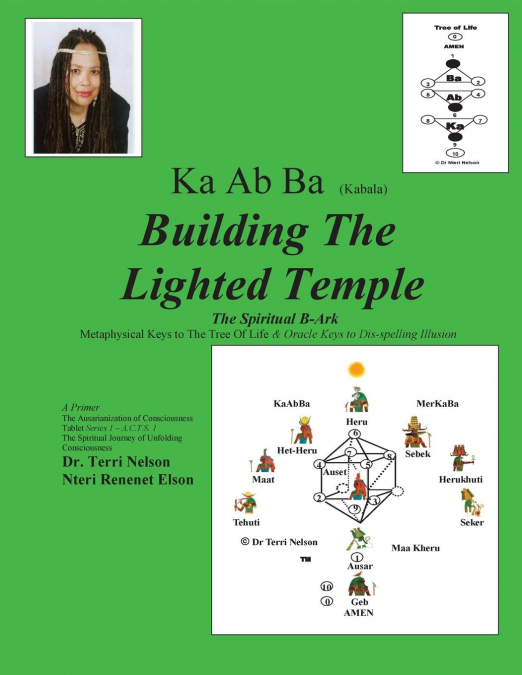
  • Ka Ab Ba Building The Lighted Temple
    Dr Terri R. Nelson / Dr Terri RNelson
    The book KaAbBa Building The Lighted Temple/Metaphysical Keys to the Tree of Life draws a circle that is inclusive of the Afrikan origin of the Ancient Kemetic/Egyptian wisdom. It reveals the undeniable root and link of Ancient Africa to all the religious systems that would develop worldwide. This book is explosive in its power to convey the meaning of KaAbBa, the Medu Neter  (...
    Disponible

    37,41 €

  • Technoethics and the Evolving Knowledge Society
    Rocci Luppicini
    Recently, there has been a major push to rediscover the ethical dimension of technology across the sciences, social sciences, and humanities. Technoethics and the Evolving Knowledge Society: Ethical Issues in Technological Design, Research, Development, and Innovation examines human processes and practices connected to technology embedded within social, political, and moral sph...
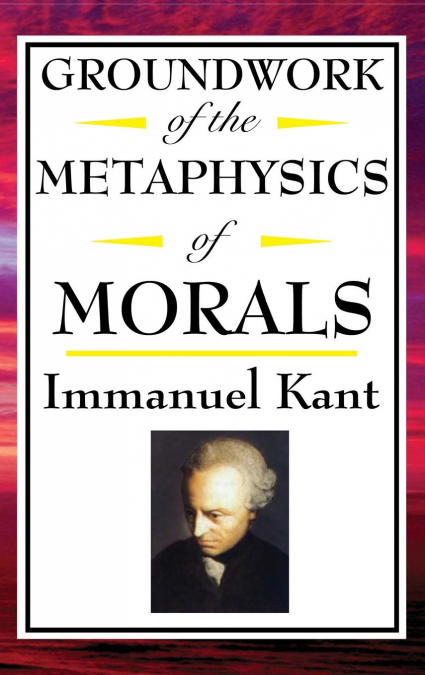
  • Kant
    Immanuel Kant
    Kant’s Groundwork of the Metaphysics of Morals is one of the most important works in modern moral philosophy. It belongs beside Plato, Aristotle, Machiavelli, and Hobbes. Here Kant sets out to articulate and defend the Categorical Imperative - the fundamental principle that underlies moral reasoning - and to lay the foundation for a comprehensive account of justice and human vi...
  • On the Duty of Civil Disobedience
    HENRY DAVID THOREAU
    Civil Disobedience argues that citizens should not permit their governments to overrule their consciences, and that they have a duty to avoid allowing their acquiescence to enable the government to make them the agents of injustice. Thoreau was motivated in part by his disgust with slavery and the Mexican-American War, but the sentiments he expresses here are just as pertinent ...
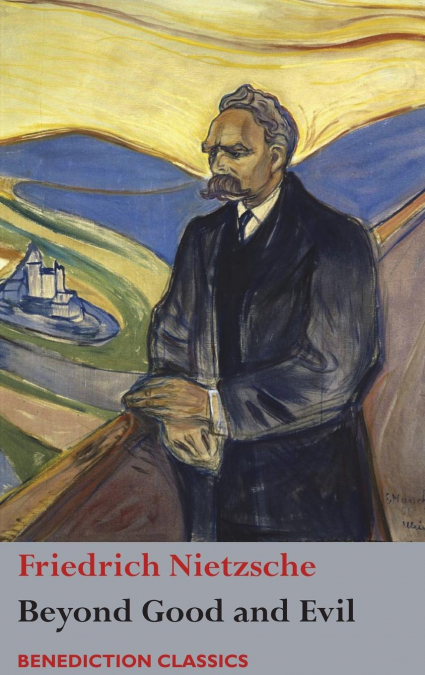
  • Beyond Good and Evil
    Friedrich Nietzsche
    Nietzsche, though primarily a philosopher, wrote widely on art, philology, history, religion, tragedy, culture, and science.  In 1886, at the height of his powers, he published Beyond Good and Evil.  Here he examines much of the best of human thought--dogmatic philosophy, Judeo-Christian morality, science and democracy – and finds it lacking.  Rejecting “slave-morality” he pres...
  • Beyond Good and Evil
    Friedrich Nietzsche
    Nietzsche, though primarily a philosopher, wrote widely on art, philology, history, religion, tragedy, culture, and science.  In 1886, at the height of his powers, he published Beyond Good and Evil.  Here he examines much of the best of human thought--dogmatic philosophy, Judeo-Christian morality, science and democracy – and finds it lacking.  Rejecting “slave-morality” he pres...
    Disponible

    9,99 €

Otros libros del autor

  • Information and Consciousness
    John M. Budd
    Information and Consciousness: An Exploration connects information and consciousness in ways that will open up potential inquiry into what information is, how it works, and its relationship to human consciousness. Information has been taken to mean many things in the past; the risk has been that, if it is taken to mean everything, it may mean nothing. In this book, information’...
  • Library as Forum in the Social Media Age
    John M. Budd
    This book lays out the purpose of libraries and, building upon that: creates a discursive practice within which conversations about essential political issues; details how the analysis of discourse can enable the conversations;sets forth a philosophical framework for the librarians and facilitators of the conversations, and more. ...
    Disponible

    51,48 €

  • Library as Forum in the Social Media Age
    John M. Budd
    Libraries may be the last location where civil, serious political discussion can take place. This book details precisely how that vision can be achieved. ...
  • Democracy, Economics, and the Public Good
    John M. Budd
    Democracy, Economics, and the Public Good provides a critical examination of essential aspects of American life, reviewing democratic and economic theories and practices and providing examination of ideas of the public good. Similar critical processes are applied to theories and practices of political economy and the public good. Throughout the text, Budd provides an investigat...