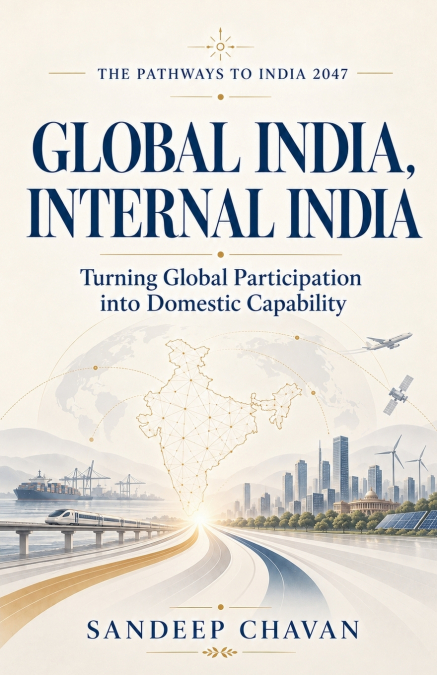
Sandeep Chavan
India is already global.Its professionals serve international companies. Its technology firms work across continents. Multinational corporations operate major centres inside the country. Global supply chains run through Indian factories. Foreign capital enters Indian enterprise, while Indian companies increasingly invest abroad. Technology, knowledge, research, management and talent continuously cross national boundaries.But participation raises a deeper question:What remains inside India after the transaction?Global India, Internal India examines the difference between economic activity taking place in India and productive capability accumulating in India.A factory can produce without deep supplier capability. A technology can be adopted without being fully understood. Thousands of professionals can be employed while important design decisions remain elsewhere. Foreign investment can generate output without necessarily building equivalent domestic research, managerial knowledge or technological depth.None of these conditions automatically represents failure.The real question is whether participation changes what India can do next.This fourth volume of The Pathways to India 2047 develops the concept of the Internal Capability Dividend: the skills, suppliers, technology, intellectual property, capital, managerial knowledge, research capacity, entrepreneurship and productive employment that remain inside India because global participation occurred.The book follows a deeper developmental chain:Global Entry → Indian Participation → Learning → Retention → Diffusion → Ownership → Domestic Application → New CapabilityThrough services, Global Capability Centres, electronics, semiconductors, manufacturing, technology, foreign investment, defence, space, biotechnology, energy and research, the book asks how participation can move from access toward absorption, from employment toward learning, from assembly toward supplier depth, and from technological use toward meaningful agency.It also rejects a false choice between global integration and self-reliance.Self-reliance does not require producing everything domestically. A deeply connected economy can remain internationally specialised while developing enough internal capability to preserve meaningful options. The important distinction is not between importing and producing, or between foreign and domestic ownership, but between participation that creates only present activity and participation that changes the next productive starting point.The book ultimately asks whether Global India and Internal India can become mutually reinforcing.Can capability developed for global customers help resolve Indian problems?Can domestic scale support stronger Indian enterprises?Can suppliers developed around multinational production serve wider markets?Can knowledge acquired through international work circulate through universities, start-ups, regions and industries?Can India become stronger globally because it has become more capable internally?This is not a prediction of India 2047.It is an examination of one of the pathways that may shape it.