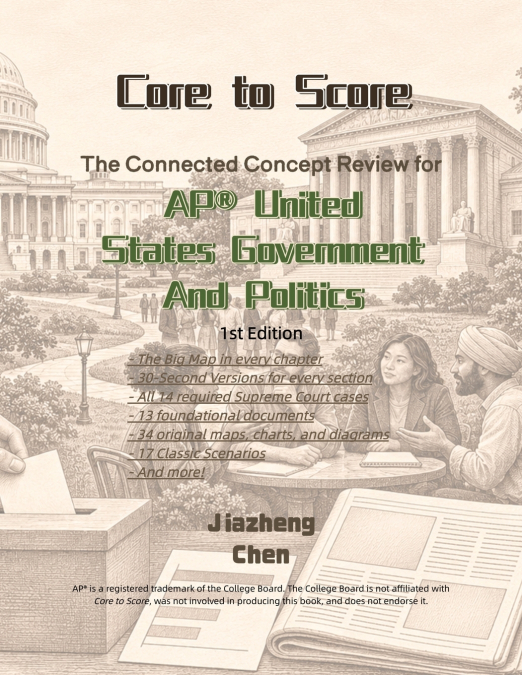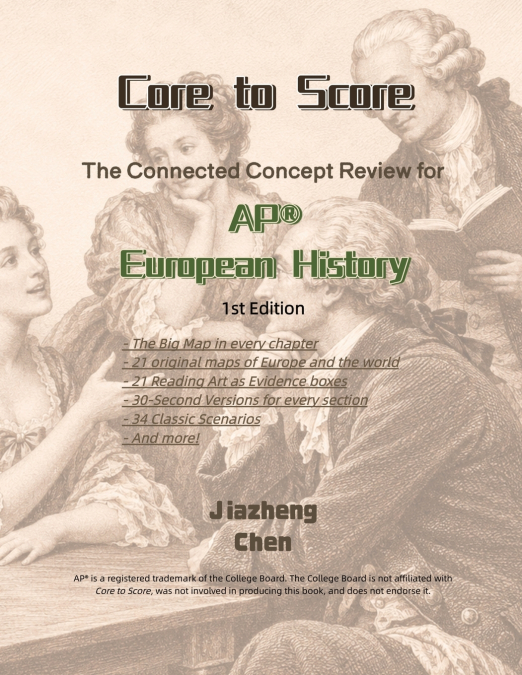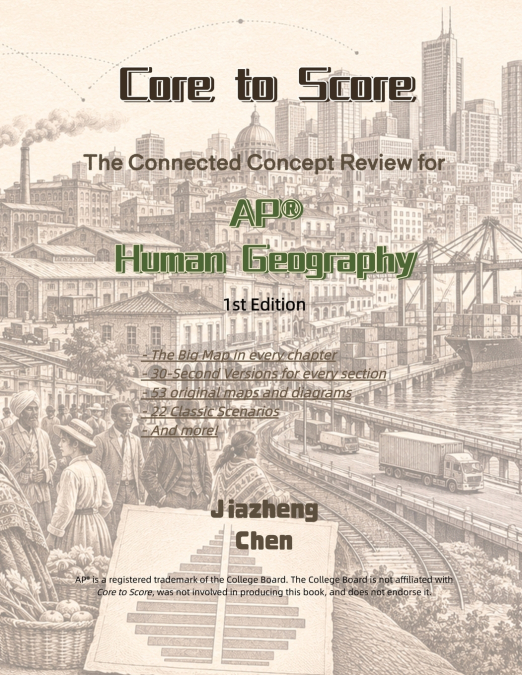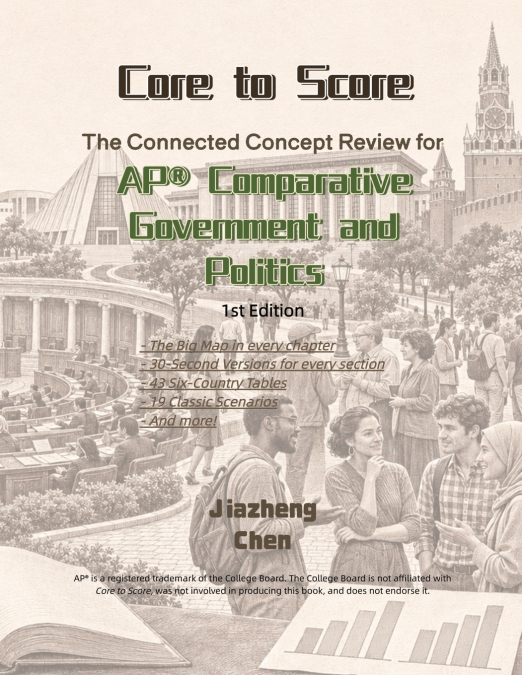
Jiazheng Chen
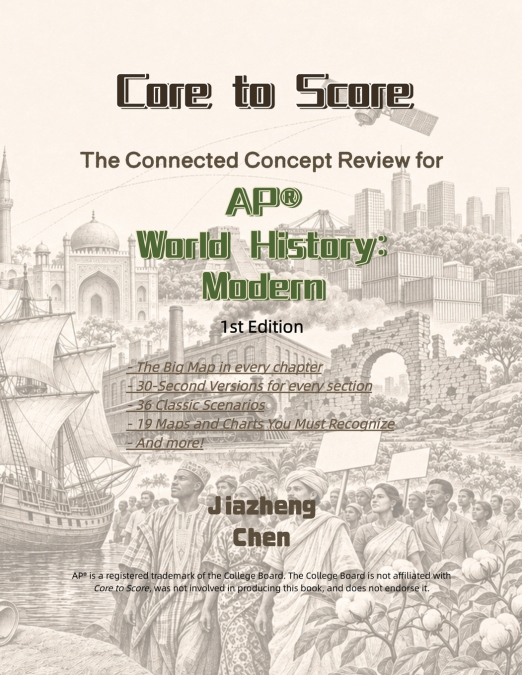
AP® World History: Modern asks you to cover eight hundred years and every inhabited continent in a single school year. Many students study it as a long list of separate stories, and many of them are surprised on exam day, when one multiple-choice set pairs a Chinese source with an African one and the long essay asks them to follow a single theme across half the course. Core to Score is written to show how the pieces connect.This concept review covers every unit and topic in the AP World History: Modern course framework, in the course’s own order, from the Global Tapestry of 1200 to the globalized world of today. Each chapter opens with the Big Map, a single timeline-based picture of the whole course that shows where you are, which developments lead into the chapter, and which ones lead out of it. Each section begins with a 30-second version you can reread the night before the exam, then explains what happened and why, how it looked to different regions and groups, and how it connects to what came before and after.Three habits run through the book. Same Time, Different Places snapshots take one year and look around the world, so you learn to compare regions the way the exam does. Threads follow trade networks, states and empires, labor systems, religion and ideas, and technology and the environment from 1200 to the present. And Thinking Like a Historian and How Do We Know? boxes show comparison, causation, continuity and change, and contextualization at work, along with the sources behind the story and whose voices they record.Inside you’ll find:every unit and topic of the course framework, with Must Know, Good to Know, and clearly labeled Beyond the Exam materialoriginal black-and-white maps and timelines in every chapter, drawn to print clearlyshort primary-source excerpts from public-domain texts and translations, each citedCommon Misconception, Watch the Wording, Word Roots, and On the Exam boxesQuick Recall questions after every section, a One-Page Summary and a spaced-review Cumulative Check for every chapter, and Classic Scenarios built around one source or situationPutting It All Together, which follows each thread across all four periods, including a full case study of labor systems from 1200 to 2001appendices with key states, people, events, and ideas; a periods-and-regions matrix and an empire comparison table; a gallery of must-know maps and visual sources; a word roots index; complete answers; and a subject indexThe book is regionally balanced, politically neutral, and careful with difficult subjects such as slavery, colonialism, and genocide. It is written for students taking the course for the first time and for anyone reviewing before the exam, and it can be used as a course companion, an eight-week review, or a last-month sprint.Pair it with Practice to Mastery: AP® World History: Modern Workbook, Practice to Mastery: AP® World History: Modern Practice Exams, and Practice to Mastery: Decoding AP® World History: Modern Free Response Questions for exam-style practice.AP® is a registered trademark of the College Board, which was not involved in the production of, and does not endorse, this product.