Ramon C. Henson
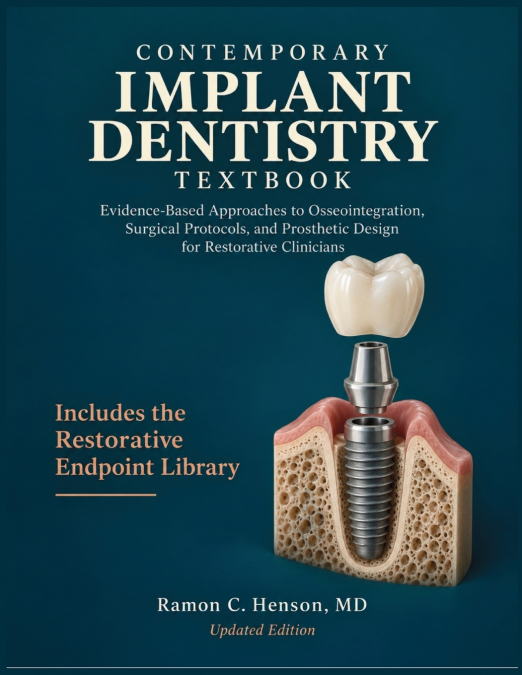
Place the implant the restoration needs, not the one the bone offers. An implant placed three millimeters too far buccally osseointegrates faithfully and is still a failure, because the crown it was placed to carry can no longer be made. This clinical reference is built around that asymmetry. Twenty-five chapters run from the biology of the bone-implant interface through cross-sectional imaging, prosthetically driven planning, surgical protocols, hard and soft tissue reconstruction, implant prosthodontics, and peri-implant disease, grounded in current society guidance including the 2025 joint consensus that named implant malposition and unfavorable prosthetic design as site-level risk factors. Every chapter names the moment after which a plan can no longer be changed. What this reference equips you to do:• Osseointegration, surface technology, and the stability trough - judge when an interface can carry load and when torque is recording compressive injury• Cross-sectional imaging read as an instrument - measure bone where the fixture will sit, and read the whole volume rather than the site• Prosthetically driven position in three planes - derive platform depth, bucco-palatal position, and screw access from the restoration before the first drill• Flap design, osteotomy, guided surgery, and immediate placement - control the steps that fix position, emergence, and retention mode permanently• Ridge preservation, guided bone regeneration, sinus elevation, and block grafting - predict outcomes by counting the bony walls that contain each defect• Abutment selection, screw versus cement retention, and emergence profile - design a transmucosal contour the patient can clean and the tissue will accept• Full-arch prostheses, overdentures, and implant occlusion - distribute load, calculate restorative space, and conceal a transition above the smile• Peri-implant mucositis, peri-implantitis, and explantation - diagnose against a recorded baseline and know when removing a fixture preserves the site Open it beside a cross-sectional image and a case not yet committed, and work backward from the restoration you intend to deliver.