Roggie Clark
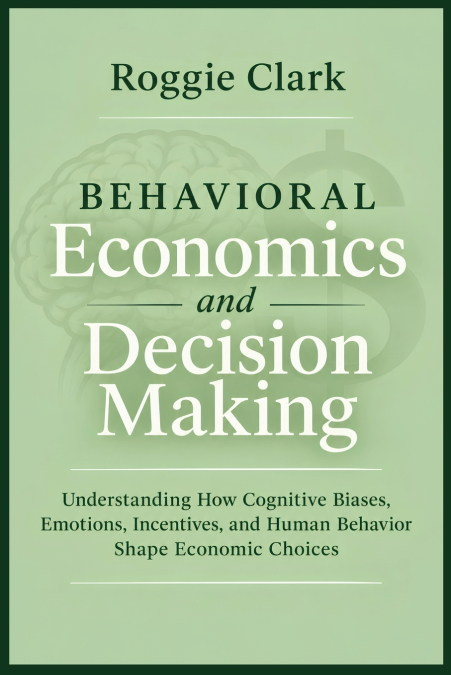
Why do people make economic decisions that contradict their long-term goals? Why do consumers respond differently to prices, incentives, and financial information? And why do emotions and cognitive biases sometimes influence decisions more than careful reasoning?Behavioral economics explores these questions by examining how psychology, human behavior, and economic principles work together to influence the choices people make.Behavioral Economics and Decision Making introduces readers to the relationship between traditional economic theory and real-world decision making. Rather than assuming individuals always make perfectly rational choices, this accessible educational guide explains how cognitive biases, emotions, expectations, incentives, and social influences affect economic behavior.Throughout this book, readers will explore foundational concepts such as bounded rationality, prospect theory, loss aversion, anchoring, mental accounting, and present bias. These concepts help explain why individuals sometimes evaluate identical economic situations differently, favor immediate rewards over future benefits, or make decisions influenced by previous experiences and expectations.The book also examines how behavioral economics applies to consumer spending, saving, financial decisions, business strategies, financial markets, and public policy. Readers will discover how pricing, framing, choice architecture, and economic uncertainty can influence individual decisions and broader market outcomes.With straightforward explanations and relatable examples, this guide connects economics, psychology, and neuroscience to provide a clearer understanding of how people make economic choices.Whether you are a student, business professional, economics enthusiast, or curious reader interested in understanding human behavior, this book offers an informative introduction to the principles of behavioral economics and their importance in everyday economic life.